
Starting from August 2025, the price of tungsten powder in the domestic market has significantly increased, which is the result of multiple intertwined factors. On the supply side, global tungsten resources are concentrated, and China's environmental regulations are becoming stricter. Some small and medium-sized mines have stopped production or implemented production restrictions for rectification. The supply of tungsten concentrate has tightened, and major tungsten enterprises have low inventory levels, resulting in a shortage of circulating spot goods in the market. The tight supply situation continues. On the demand side, as an "industrial tooth", hard alloys are widely used, and downstream market demand is steadily growing. The upgrading of the manufacturing industry has driven an increase in demand for high-end hard alloys, which has a strong driving force on tungsten powder. In addition, the production process of tungsten powder is complex, energy consumption is high, and the rising production costs of electricity, auxiliary materials, etc. also support its price. The core lies in the structural imbalance between supply and demand and the resonance of the macro environment. The normalization of domestic environmental inspections on the supply side restricts mining operations, and international geopolitics affects trade flows; The demand for tungsten wire for photovoltaic cutting lines on the demand side has exploded, and the penetration rate of CNC cutting tools in the high-end field has increased. Multiple factors have led to a rigid increase in the price of tungsten powder, which is difficult to fall back in the short term.
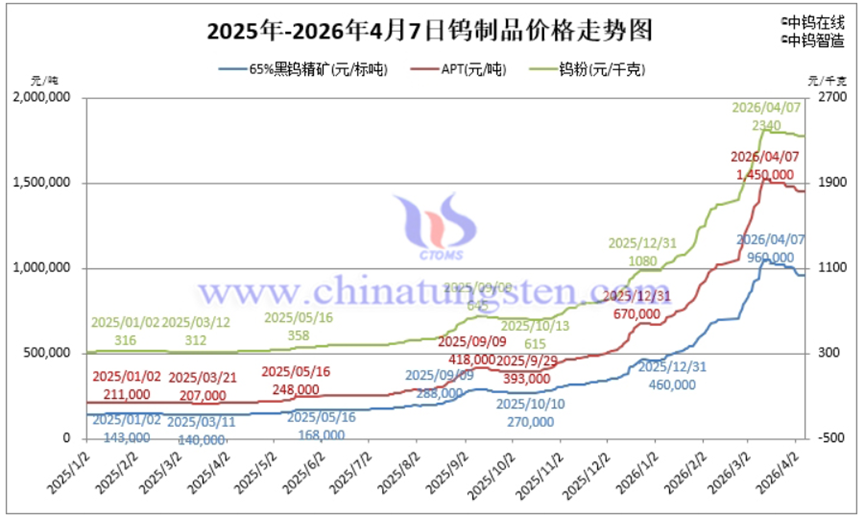
The rise in tungsten powder prices has driven up the prices of hard alloys and diamond composite sheets
Tungsten powder is the core raw material of cemented carbide, accounting for over 60% of the cost. For every one percentage point increase in its price, the production cost of cemented carbide increases by about 0.6%, indicating a significant conduction effect. The structure of diamond composite sheet is composed of diamond layer and hard alloy matrix, with the hard alloy matrix accounting for about 40% to 50% of the total cost. The rise in hard alloy prices will inevitably drive up the cost of diamond composite sheet, and the production process requirements for diamond layer are high, with low qualification rate, resulting in a more significant overall cost increase. The fluctuation of raw material prices is transmitted step by step along the industrial chain, increasing the cost pressure on downstream enterprises. For example, in factories that produce CNC cutting tools, the proportion of raw material costs to total costs has increased from around 50% to 80%. In enterprises that produce diamond composite drill bits for mining, material costs have also increased by 100%. However, the increase in ex factory prices is limited, and profits have dropped significantly. Some small factories have stopped some production lines.
Analysis of the Rapid Increase in Enterprise Costs
Enterprises that mainly use hard alloys and diamond composite sheets as raw materials face multidimensional pressure of cost increase. The procurement cost of raw materials has significantly increased, and the fluctuation of tungsten powder prices makes it difficult for enterprises to predict the timing of procurement, increasing the difficulty of inventory management and capital occupation. The efficiency bottleneck of traditional machining methods exacerbates the cost burden. Although EDM discharge machining can meet cutting needs, the machining speed is slow, and the auxiliary material costs such as electrode loss and liquid oil consumption are high. The long processing time of a single piece leads to high comprehensive costs. Downstream customers are highly sensitive to prices, and there is limited room for product price increases. Enterprises find it difficult to fully transfer cost increases to the market, resulting in a severe compression of profit margins. Some small and medium-sized enterprises are facing survival pressure and urgently need to find ways to reduce costs.
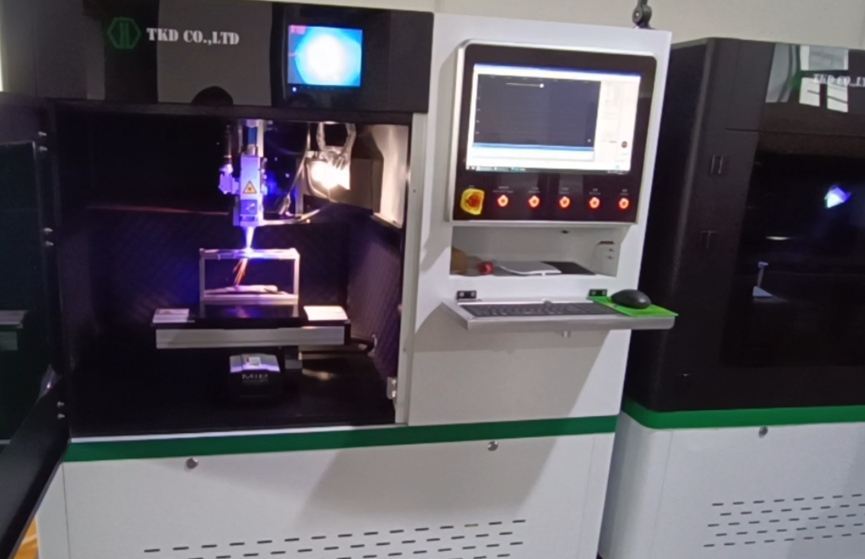
Comparative Analysis of Costs between Fiber Laser Cutting and EDM Cutting
| ITEM | EDM Cutting | TKD Fiber laser cutting | Benefit |
| Cutting kerf | 0.2mm - 0.3mm | 0.05mm | Precision 4 times up |
| Material Utilization Rate | about 70% | About 92% | Material saved 22% |
| Cutting Speed | Up to 25mm/min | Up to 220mm/min | Rate improve up to 10+times |
| Consumables demand | Electrode wire, machining fluid (high) | Almost no consumables | Significant reduction in operating costs |
(1) Economic Comparison of Technological Substitution (Taking Cutting Φ 50mm Hard Alloy Cylindrical Teeth as an Example)
processing efficiency
Laser cutting speed far exceeds EDM. When EDM cuts hard alloys, the discharge corrosion rate is limited, and it takes several minutes to cut millimeter sized incisions; Fiber laser can complete the same or even finer cutting within seconds, increasing production efficiency by several times or even more than ten times. Under the same output, labor costs and equipment depreciation are significantly reduced.
Consumables cost
EDM requires regular replacement of consumables such as electrode wires and machining fluids, and electrode wires are expensive; Fiber laser cutting hardly generates such consumption, and the operating cost is controllable. And the cost of laser equipment is low, but with efficient processing speed and extremely low single piece consumables cost, the comprehensive cost advantage of long-term use is more obvious.
processing quality
Laser cutting has a smaller heat affected zone and higher surface smoothness, which can reduce subsequent precision machining processes and save time and costs. For high-value materials such as diamond composite sheets, improving processing quality can also reduce scrap rates and indirectly create economic benefits.
Material Utilization Rate
The narrowest EDM cutting seam is 0.2mm, and the cutting process burns the edges of the material, making it difficult to reuse the remaining material. The overall material utilization rate is about 70%; The narrowest gap of fiber laser cutting is 0.05mm, with high cutting-edge accuracy. The remaining material can be cut and reused again, and the overall material utilization rate is over 92%. Taking cutting 10mm thick hard alloy sheets as an example, for every 100 kilograms of material cut, laser cutting can save 17 kilograms of hard alloy. Calculated at a price of 1200 yuan/kilogram, it can save nearly 20000 yuan in material costs. The total cost of EDM for processing a batch of workpieces is about three times that of laser cutting.
Full lifecycle cost
The initial investment of fiber laser equipment is relatively low, and under the normal operation of high raw material prices, the comprehensive benefits created by saving materials, improving efficiency, and reducing post-processing can be recovered in a relatively short period of time. For hard alloy and PDC processing enterprises, process upgrading is a survival strategy to hedge against fluctuations in raw material costs and maintain profit margins.
The strategic value of fiber laser cutting machine in offsetting cost reduction
Against the backdrop of sustained high tungsten powder prices, fiber laser cutting machines can to some extent counteract the pressure of rising raw material costs and provide practical cost reduction solutions for related manufacturing enterprises. The introduction of fiber laser cutting technology by enterprises is not only a practical choice to cope with the current cost dilemma, but also a long-term layout to enhance competitiveness. Although it cannot fully cover the cost increase caused by the subsequent significant increase in tungsten prices, it is currently the most direct and effective way for downstream enterprises to reduce costs. Enterprises should calculate their long-term accounts well, offset material inflation through technological upgrades, and take the initiative in the industry reshuffle. For example, many factories that have switched to fiber laser cutting have seen a 15% reduction in material costs and a 40% reduction in processing costs after changing equipment. This just offsets the cost increase caused by the rise in raw material prices, and some high-efficiency factories have slightly higher profits than before the price increase.


 Whatsapp/wechat